AI & NICO - Explainable AI for Identity Governance
NEXIS brings AI directly into identity governance to detect anomalies, improve data quality, and support complex decisions with transparent recommendations. NICO, the NEXIS Intelligent Co-Pilot, helps teams act on identity, entitlement, and risk data without removing human accountability.
AI in IAM Only Works When Decisions Stay Governed
Identity governance teams work across large volumes of identities, roles, entitlements, and risk signals. AI helps detect anomalies, improve data quality, and support complex decisions at scale, but recommendations must remain transparent and accountable.
AI is not a black box and not a replacement for decision makers. NEXIS uses AI to enrich governance processes with facts, reasoning, and remediation guidance while keeping final responsibility with the people who approve, certify, and govern access.
Risk Indicators
- Identity data is too fragmented for manual analysis
- Anomalies remain hidden across systems
- Governance teams lack context for faster decisions
- Documentation effort remains manual and repetitive
- AI outputs cannot be explained to auditors or reviewers
Meet NICO, the NEXIS Intelligent Co-Pilot
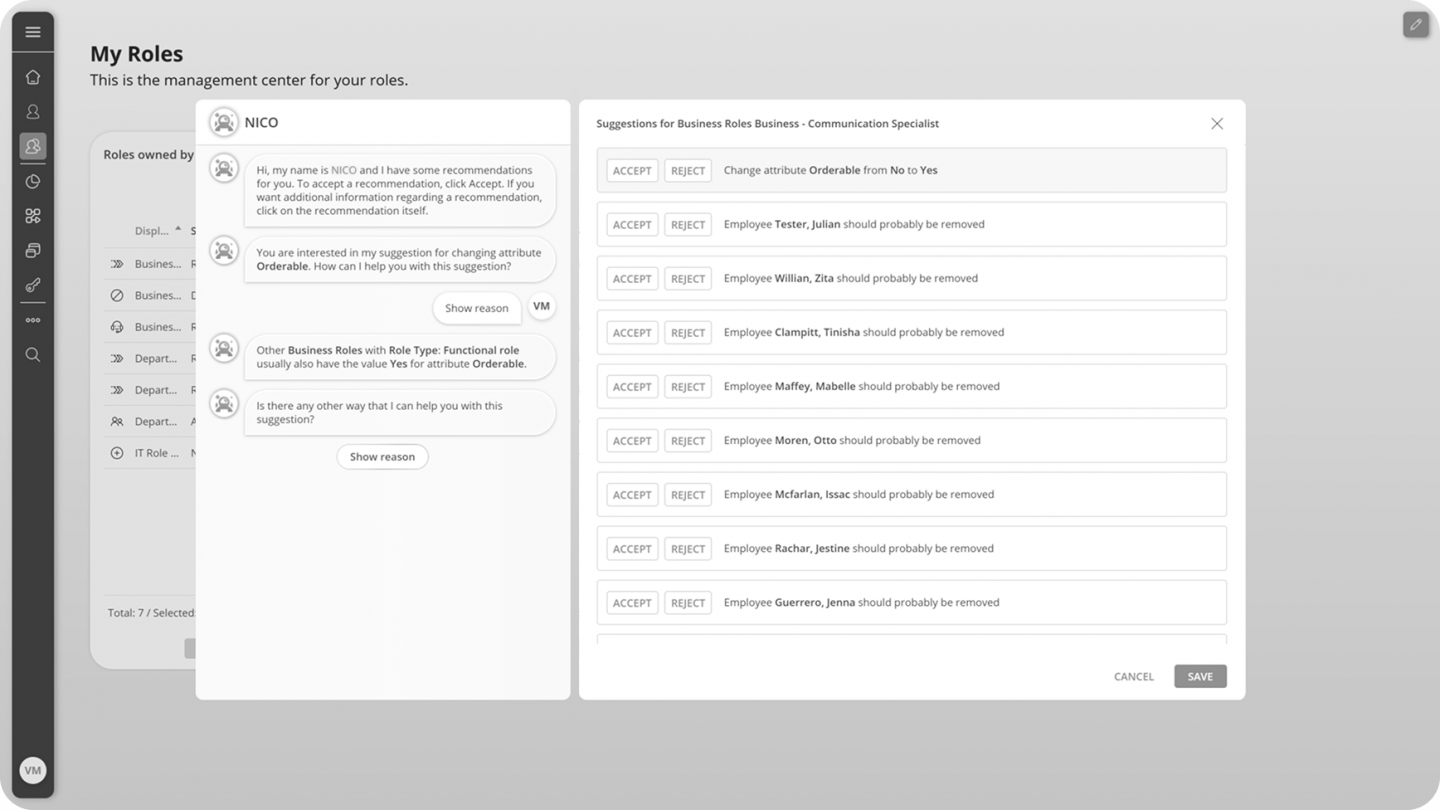
NICO brings the power of ML and LLMs directly into everyday IAM processes.
Explainable Recommendations
NICO provides recommendations with clear reasoning so governance teams can understand why a decision matters before acting on it.
Better Data Quality and Detection
Machine learning identifies anomalies, toxic combinations, and inconsistencies across identities, roles, and entitlements while supporting continuous improvement of role and attribute quality.
Support Across Core IAM Processes
NICO supports recertification, role mining, access analysis, and application onboarding as part of day-to-day IAM work.
Governed Language-Based Assistance
Large language models support document interpretation, IAM governance documentation generation and refinement, and conversational access to identity data with traceability.
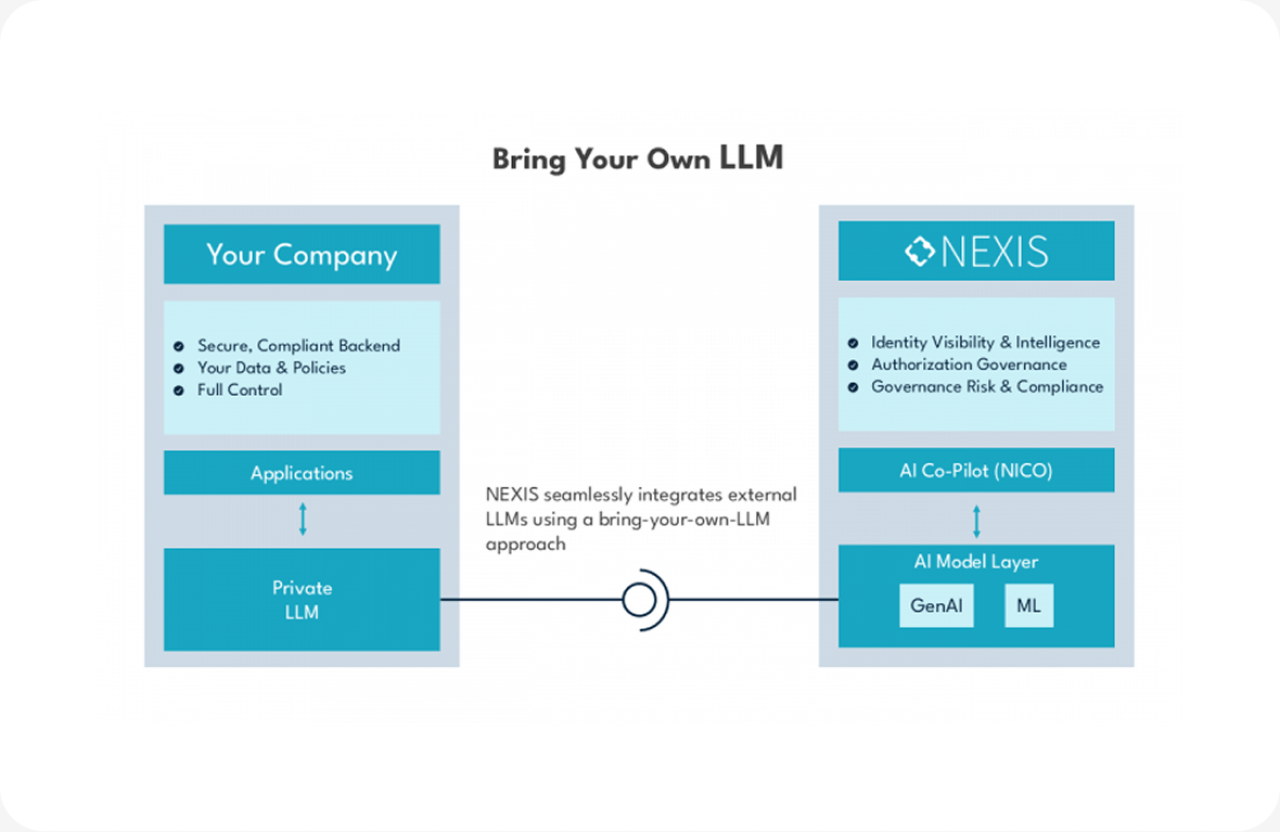
Use Your Own Enterprise LLM as the GenAI Backend
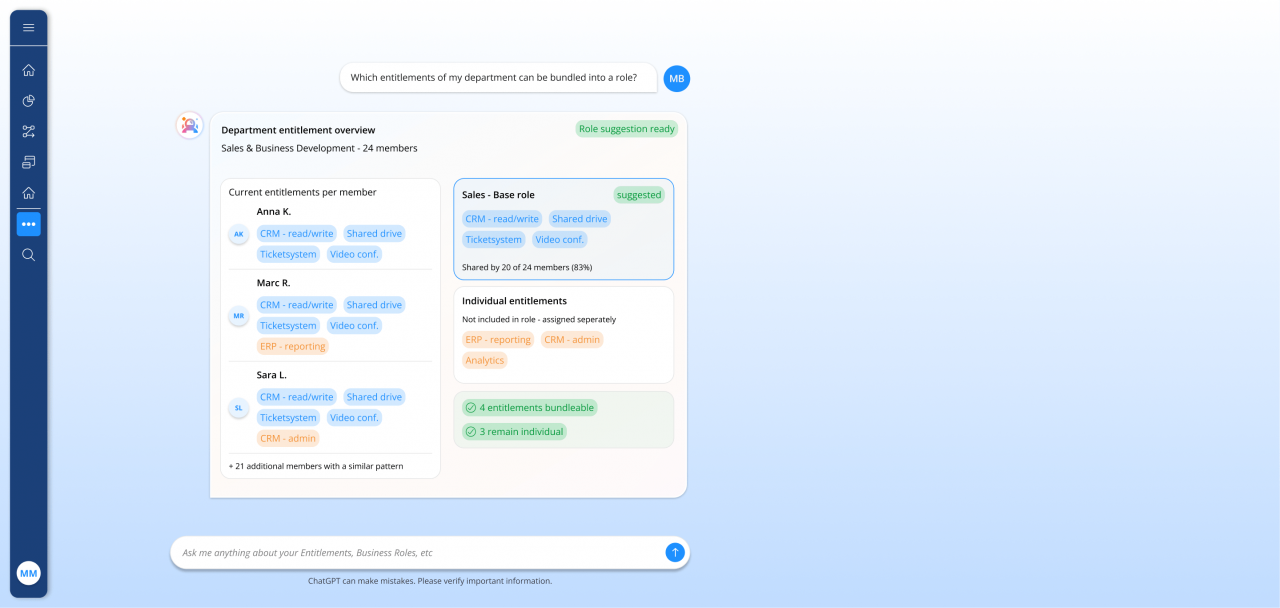
NEXIS allows organizations to connect their own enterprise LLM as the generative AI backend for NICO. This keeps AI-assisted governance within the customer’s trusted AI environment while extending NEXIS with language-based support for identity, authorization, and governance processes.
Users continue to work in NEXIS, but benefit from the data, context, and control already established in the organization’s own LLM environment. There is no need to introduce a separate AI workflow or move governance activities into another tool.
With MCP, NEXIS becomes a fully integrated AI-enabled governance layer powered by the customer’s own LLM. This creates a unique deployment model: explainable identity governance in NEXIS, combined with enterprise-controlled GenAI in the environment the organization already trusts.
MCP - Open Data Access for AI and Customer LLMs
NEXIS exposes identity and authorization intelligence through the Model Context Protocol (MCP), giving AI systems secure access to governed IAM and governance data. This allows organizations to connect customer-specific LLMs and AI agents without breaking the control model that protects identity-related information.
This supports:
- Secure, structured access to identity and governance data
- Integration with customer-specific LLMs and AI environments
- AI-assisted use cases such as SoD analysis, governance documentation, and anomaly detection
NEXIS AI Capabilities Power Key Use Cases
NICO supports recertification with explainable recommendations and decision context so reviewers can act on more than isolated entitlement lists.
Explore Use Case
Machine learning supports peer-group comparison, anomaly detection, and continuous role optimization, while NICO assists with role mining directly.
Explore Use Case
Large language models help interpret onboarding documents, while NICO supports authorization documentation and concept generation with less manual effort.
Explore Use Case
AI supports cross-system SoD conflict detection, identity visibility, IAM hygiene, and explainable recommendations tied to governance action.
Explore Use Case
Secure, Compliant AI for Regulated Environments
NEXIS applies AI to identity governance in a way that remains explainable, reviewable, and aligned to control requirements. Strong IAM hygiene, transparent recommendations, and governed use of enterprise or local language models support regulated environments with higher expectations around accountability, security, and data sovereignty.
AI in alignment with:
- GDPR
- NIS2
- DORA
- and industry regulations.