






Governance and Identity for Financial Services

Align identity governance with financial risk and compliance.

Regulatory Pressure Requires Operational Governance

Financial institutions must manage identity, risk, and compliance simultaneously. Organizations need continuous visibility across complex landscapes to ensure documented governance.

DORA

Enhances digital operational resilience for the financial sector through strict IT risk management.

BAIT

Defines supervisory requirements for IT in German financial institutions to ensure secure operations.

VAIT

Sets specialized IT security and governance standards for the insurance industry's regulatory compliance.

NIS2

Modernizes cybersecurity requirements across the EU to protect critical infrastructure and digital services.

ISO 27001

Provides the international gold standard for establishing and maintaining a robust Information Security Management System.

GDPR

Enforces strict data protection and privacy standards for handling personal information within the EU.

Common Governance Challenges

Audit-Proof Evidence

Auditors require proof that controls are effective. Maintain traceable and continuously validated evidence that stands up to scrutiny.

Evolving Regulatory Obligations

Supervisory frameworks continue to expand. Adapt governance processes and documentation for ongoing adherence to changing rules.

Complex IT Landscapes

Banks and insurers operate highly interconnected application environments. Establish consistent governance controls across fragmented, legacy systems.

Authorization Risk

Overly complex or outdated role structures increase security exposure. Reduce unauthorized access and eliminate critical audit findings.

What Strong Governance Looks Like in Financial Services

Controlled Access by Design

Roles and entitlements are clearly defined and continuously monitored.

Audit Evidence Available on Demand

Governance documentation and control status are available without manual reconstruction.

Identity Linked to Risk Oversight

Identity-related weaknesses are visible as governance and risk issues.

Shared Governance Model

Security, compliance, IAM, and audit teams operate from a unified framework.

Governance & Identity
Applied in Financial Services

Risk Governance

Access risks are operational risks.

Analytics enables:

  • Continuous monitoring of toxic access
  • Risk classification and prioritization
  • Integration into enterprise risk registers
  • Escalation workflows

Result:

Identity becomes part of active risk governance, not an isolated IT process.

IAM Modernization

Modern IAM initiatives often fail due to unclear role structures and legacy entitlements.

Identity analytics supports:

  • Role rationalization
  • Entitlement cleanup
  • Migration readiness
  • Transparent baseline assessment

Result:

Faster transformation with reduced risk.

Audit & Regulatory Compliance

Gain continuous transparency across identities, risks, and controls instead of using disconnected tools.

Identity analytics provides:

  • A defensible identity inventory
  • Structured entitlement transparency
  • Automated SoD conflict detection
  • Evidence aligned with ISO 27001, DORA and NIS2

Result:

Reduced audit preparation effort and higher evidence quality.

How We Address
Your Challenges

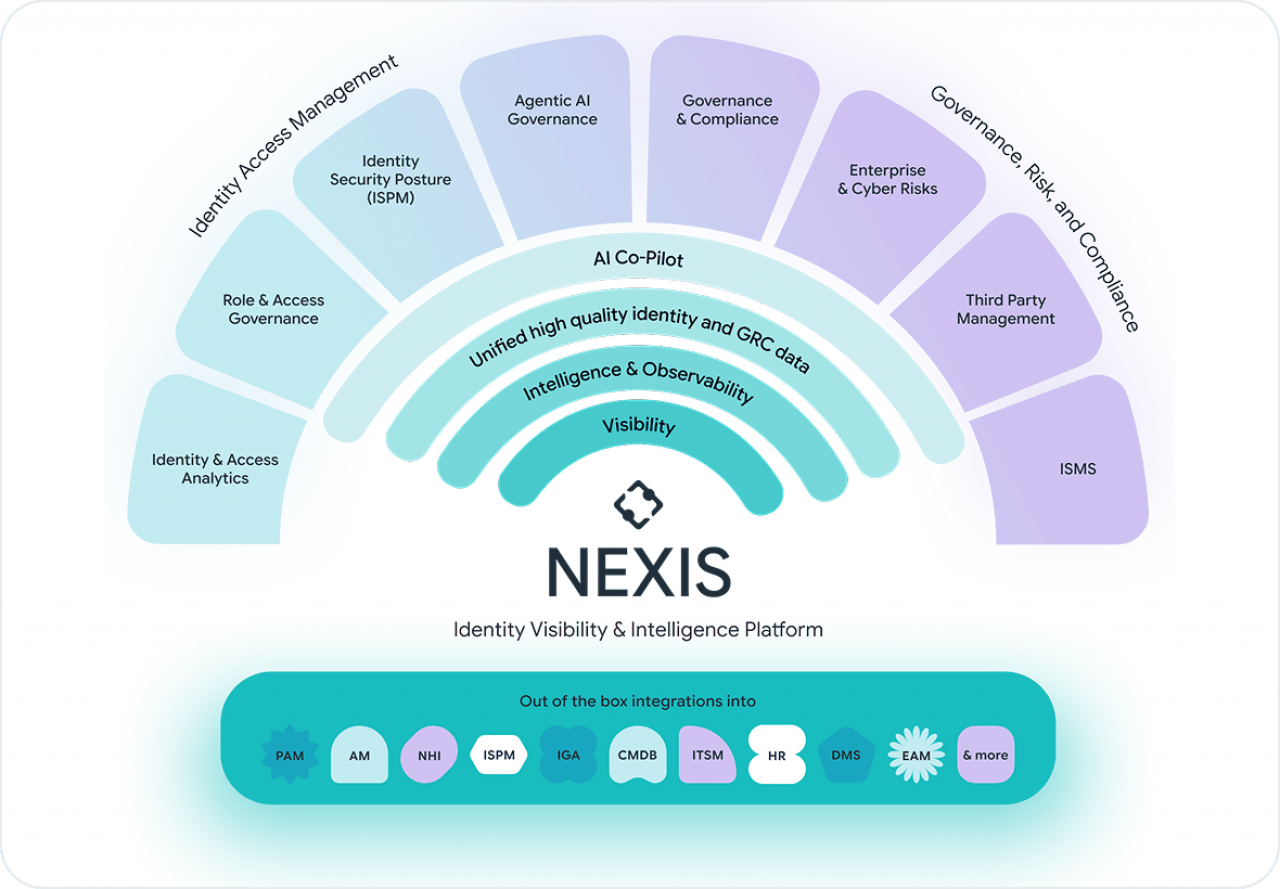
NEXIS effectively supports financial sector governance

Identify & Assess

Map your regulatory scope, existing controls, and identity risks into a unified register.

Govern & Control

Apply GRC frameworks and IAM policies – automated, continuous, audit-ready.

Monitor & Alert

Real-time dashboards surface compliance gaps and access anomalies before they become incidents.

Report & Prove

One-click reporting for BaFin, BSI, and internal auditors — from a single source of truth.

Customer Success Stories

Explore All Case Studies

Experience Unified Governance

See how NEXIS transforms fragmented identity and risk processes into a single, high-clarity management platform.