

UNIQA Strengthens Identity Governance and Compliance with NEXIS
This case study shows how UNIQA strengthened identity governance and compliance with NEXIS – one of Europe’s leading insurance groups...
Decentralized Identity Governance for Enterprises That Cannot Afford Bottlenecks
NEXIS distributes role management, authorization tasks, and governance activities to the departments that own them while IAM retains central visibility, policy enforcement, and audit control.
When IAM Becomes the Bottleneck, Governance Slows Down
In large organizations, identity governance still runs through a central IAM team. Role requests, recertification campaigns, and documentation updates all go through IT. Business departments wait, IAM teams are overloaded, and neither side benefits.
DORA, BAIT, and VAIT require governance that is structured, traceable, and defensible, but not fully centralized. The challenge is to distribute the workload without losing control. Yet the departments that define business processes and understand which roles are needed are still excluded from governance execution. Decentralized identity governance changes that.
When Ownership Moves to the Business,
Governance Gets Stronger
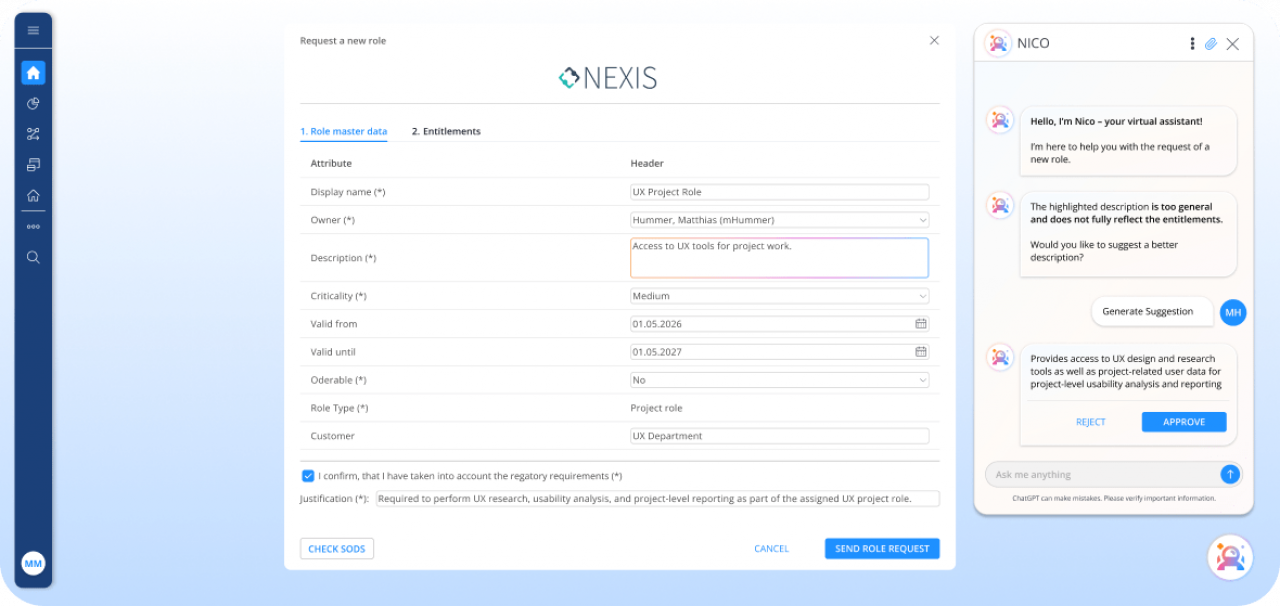
Role Ownership Where It Belongs
Business departments create, maintain, and retire roles without routing every change through central IT.
AI-Assisted Documentation
Application owners create IAM governance documentation directly in NEXIS with guided support based on existing system data.
Compliance Without the Overhead
SoD checks run in the background so governance remains enforced without manual intervention at every step.
Recertification Without Manual Coordination
Reviews are assigned automatically to the right managers, role owners, and application owners at the right time.
The long-term goal of decentralized governance is not just faster processing. It is an operating model in which roles remain accurate by design, recertifications confirm rather than correct, and no single team carries disproportionate operational weight. NEXIS supports that trajectory by combining delegation, automation, and continuous policy enforcement.
This case study shows how UNIQA strengthened identity governance and compliance with NEXIS – one of Europe’s leading insurance groups...
CSS achieved structured IAM governance and recertification by standardizing heterogeneous access environments, automating recertifications, and introducing scalable, audit-ready role management...
Related NEXIS Platform Capabilities
Support business-owned role lifecycle processes with controlled creation, maintenance, ownership, and retirement.
Maintain structured workflows, documentation, approval records, and audit-ready governance evidence.
Apply SoD controls across requests, role changes, and delegated governance tasks.
Reduce manual effort in governance documentation with guided support based on existing access data.