
Continuous Compliance Monitoring with Automated Evidence Collection
NEXIS enables continuous compliance monitoring, reducing manual audit preparation time while maintaining audit-ready evidence across governed systems, controls, and processes.
Manual Evidence Collection
Delays Audits & Increases Risk
Regulated organizations already document their controls, yet proving those controls work remains a manual, last-minute effort. Evidence collection typically starts weeks before an audit, scattered across teams and applications.
Application and system owners gather screenshots and exports by hand. Evidence quality varies between departments, and compliance teams rarely have a current view of which controls actually hold. Few teams validate documented requirements against live system settings.
The result is predictable: gaps surface too late, audit preparation drains scarce resources, and proving compliance becomes a recurring scramble instead of a continuous state.
Risk Indicators
- Evidence collection starts weeks before audits
- Application owners collect screenshots manually
- Compliance teams lack current control visibility
- Evidence quality varies across departments
- Gaps are discovered too late
- Documented requirements are not validated against settings
How NEXIS Turns Requirements into Provable Compliance
NEXIS integrates evidence requirements directly into governance documentation and control frameworks. Once a requirement defines what must be proven, a single governed workflow handles the rest: request, collection, validation, and the link back to documentation. NICO performs the validation as a dedicated NEXIS service that stays available and current, or runs in an organization's own environment.
Evidence Requirement Definition
Evidence requirements are defined directly within IAM governance documentation and can be linked to any governed item, such as a specific application, service, asset, or control. Each carries the criteria NICO judges against, a working instruction for the owner, and the confidence threshold, so identical evidence is always judged the same way.
Visual and Text-Based Evidence Collection
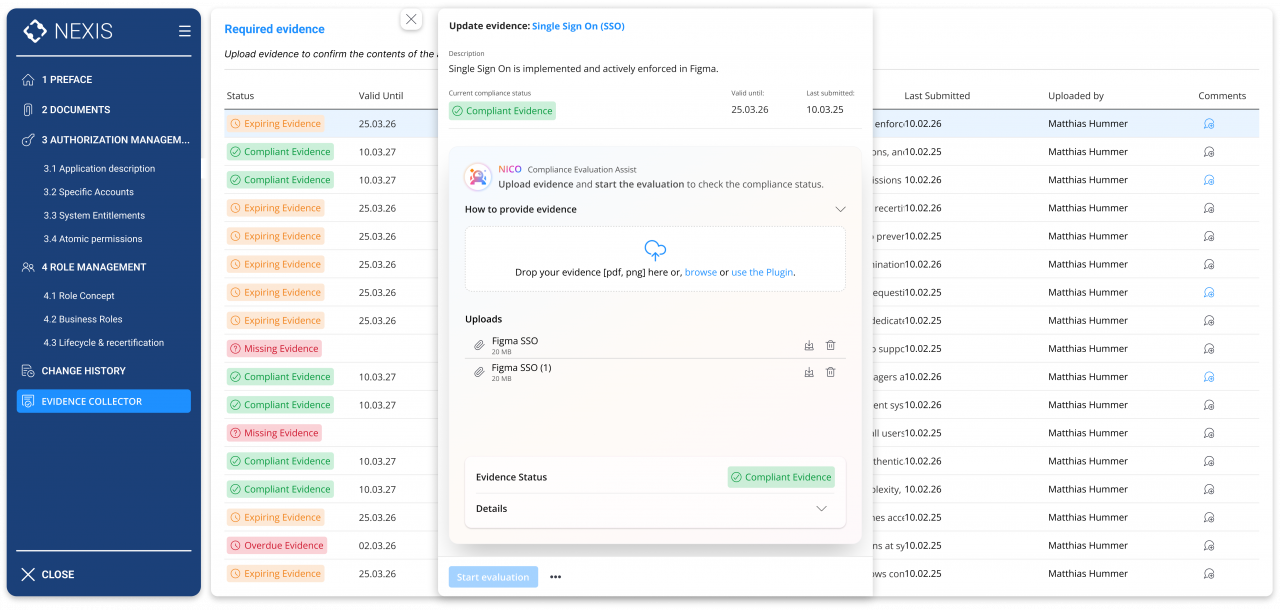
Owners provide evidence while they work, without leaving their task. Evidence can be uploaded directly on the documentation field, opened through the dedicated Evidence Collector overview, or captured straight from the target system with the browser plugin. Each requirement shows its own status, so owners see at once whether a submission was accepted. Every submission is preserved unchanged and time-stamped, and retained with version history so evidence can be compared across collection periods.
AI-Assisted Quality Validation
NICO reads each submission, including images via OCR, screens it for manipulation, and applies the defined criteria. It returns a compliant or non-compliant verdict with a confidence rating and reasoning. Evidence above the threshold is accepted automatically; the rest is flagged for review.
Automated Documentation Integration
Accepted evidence links automatically to the governance documentation or audit framework it supports and the compliance status updates on its own. Every evaluation is recorded with the evidence, timestamp, confidence, and reasoning, so auditors move directly between a requirement and its proof.
Gap Visibility and Follow-Up
Any requirement still without accepted evidence stays visible as a gap, so nothing is quietly missed. Owners can be prompted for the missing proof, and because expired evidence is automatically re-requested, gaps are surfaced and closed before the next audit cycle rather than discovered during it.
Evidence Collection Becomes
Continuous, Not Crisis-Driven
With NEXIS Evidence Collector, audit preparation shifts from weeks of manual coordination to a faster process centered on retrieving evidence that is already available. Compliance teams gain clearer visibility into current control effectiveness, while system owners incorporate evidence collection into normal operations instead of treating it as a separate audit task.
The result:
Audit-ready documentation on demand
Consistent and centrally governed criteria
AI-assisted evidence validation with confidence ratings
Traceable, tamper-proof evidence
Evidence Collector in Practice
Organizations use NEXIS Evidence Collector across multiple compliance scenarios, from proving application security configurations to demonstrating SoD enforcement to validating role model implementation.
Application Security Configuration Compliance
IAM governance documentation requires specific security settings enabled in integrated applications - password complexity, session timeout, encryption standards. Manual verification is periodic and reactive.
What NEXIS provides
- Evidence requirements defined in IAM governance documentation, each with its own working instruction and criteria
- Owners capture proof straight from the target system with the browser plugin, for example a screenshot of an SSO integration with Microsoft Entra ID
- NICO validates the evidence with a confidence rating before acceptance
- Automatic documentation linkage for auditor access
Result:
Application security compliance becomes continuously verifiable instead of an audit-preparation exercise.
Segregation of Duties (SoD) Enforcement Proof
When SoD policies identify high-risk conflicts or require compensating controls, NEXIS can support evidence collection.
What NEXIS provides:
- Evidence requests automatically generated from SoD policy violations or high-risk combinations
- Risk owners submit evidence of compensating controls or remediation
- NICO validates that the evidence addresses the identified SoD risk and rates its confidence
- Complete audit trail from SoD policy to violation detection to evidence and resolution
Result:
SoD compliance becomes demonstrable with timestamped evidence trail rather than relying on point-in-time reports.
IAM Governance Documentation Validation
When governance documentation defines role models, approval workflows, or lifecycle processes, NEXIS can embed the related evidence requirement directly into the documentation.
What NEXIS provides:
- Evidence requirements embedded in governance documentation
- Workflow-based evidence collection from process participants
- NICO validates that the collected evidence matches the documented procedures and rates its confidence
- Version-controlled evidence showing process consistency over time
Result:
Governance documentation becomes evidence-backed and operational, rather than a static reference questioned during audits.