AI Agent Governance Built on Proven IGA Foundations
AI agents, service accounts, and automated pipelines now outnumber human identities by a factor of 50 to 140. NEXIS governs them with the same rigor, lifecycle workflows, and access controls already in place for your workforce.
Most Organizations Govern Their People. Almost None Govern Their Agents.
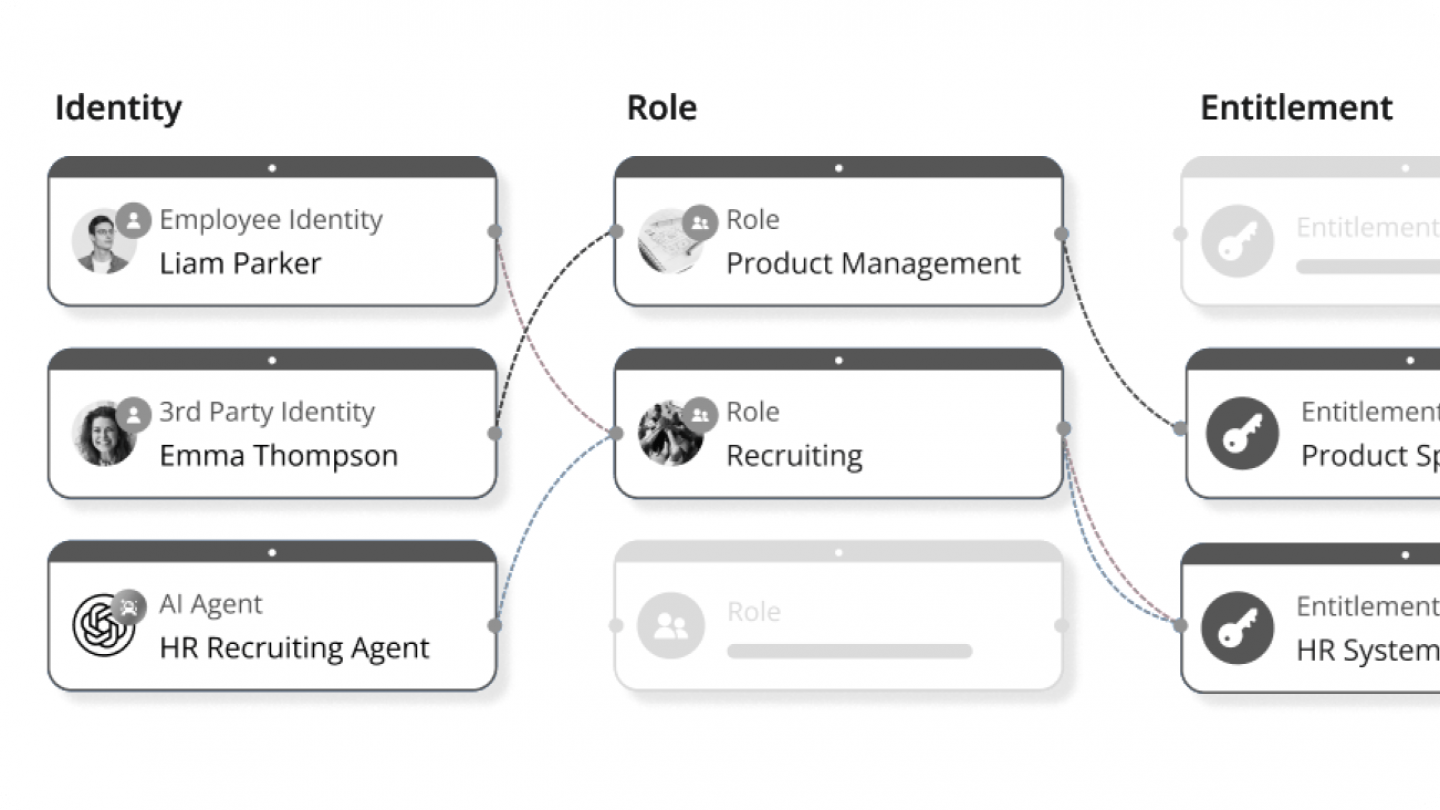
Non-human identities already outnumber human identities in most enterprise environments, and their volume continues to grow through automated integrations, service accounts, and AI-based workflows. Yet most identity governance processes still assume that every relevant identity is a person.
Agents are created outside standard governance workflows, accumulate permissions over time, and often remain active after the employee who created or owned them has left. This leaves structural gaps in ownership, lifecycle control, and accountability.
The risk grows further when external AI services access internal data without clear policy boundaries or third-party governance. IAM alone cannot address this without coordinated control across access, ownership, and risk.
Risk Indicators
- Agents created outside governance enrollment
- No owner after the creator departs
- Permissions accumulate without review
- SoD controls exclude non-human identities
- External AI services lack governance review
- No formal decommissioning for agents
From Invisible Actors to Governed Identities: How NEXIS Governs AI Agents
The shift is structural. AI agents stop existing outside governance and begin operating under the same accountability, lifecycle processes, and access controls already used for the workforce. NEXIS extends an existing governance model to a new identity class instead of creating a parallel one.
1. Discover and Register
AI agents and non-human identities are surfaced across the environment and enrolled in NEXIS with the attributes needed for governance.
2. Assign Ownership
Each agent is linked to a human owner. Ownership is tracked continuously and triggered for reassignment when that owner leaves the organization.
3. Define and Enforce Authorization
Policy-based authorization defines which systems, data classes, and actions each agent may access. SoD rules can be applied at policy level across connected environments.
4. Certify and Maintain
Periodic recertification validates whether agents still require their access and whether assigned policies remain appropriate. Decisions are logged for audit and review.
Know What Every Identity Can Access
and Who Can Access Everything
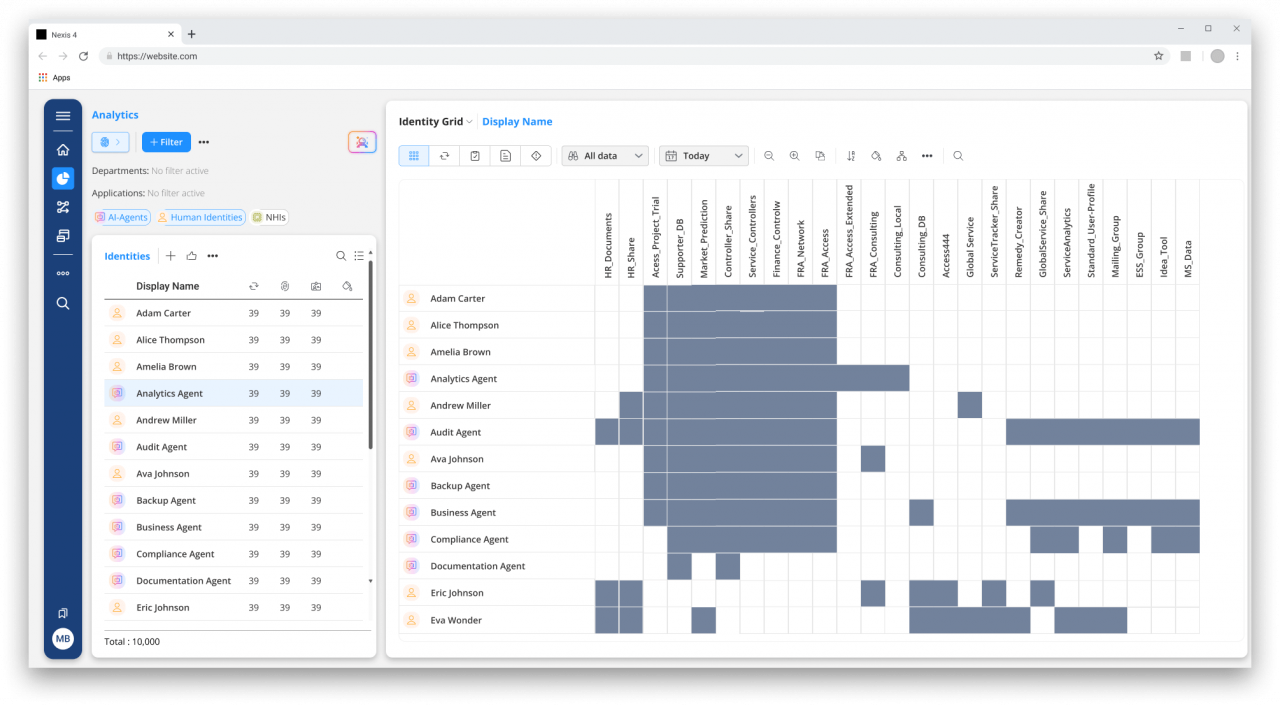
Access in modern environments is distributed across roles, entitlements, rights, and resources, and a single identity may reach data through multiple overlapping paths.
How Organizations Apply Agentic AI Governance
NEXIS applies the same governance architecture to AI agents regardless of whether the challenge is ownership accountability, access compliance, or audit-readiness.
Agent Offboarding and Ownership Continuity
When an employee who created or managed AI agents leaves the organization, those agents often remain active with no accountable owner. NEXIS includes mandatory ownership checks in offboarding workflows, surfaces all agents linked to the departing identity, and enforces reassignment or revocation before offboarding is complete.
NEXIS supports:
- Mandatory ownership checks for non-human identities within the offboarding workflow
- Automatic identification of agents owned by the departing employee (via Astrix integration if deployed)
- Enforced reassignment or revocation before offboarding is completed
- Full decision trail captured in NEXIS audit log
Result:
No orphaned agents and no unmanaged access left behind by workforce changes.
Access Certification for Agents and Their Policies
Compliance expectations increasingly extend to non-human identities. NEXIS includes agents and their policies in structured recertification campaigns so ownership, access scope, and SoD exposure can be reviewed on the same governance cadence as workforce identities.
NEXIS supports:
- Independent certification of PBAC policies to support high agent volumes
- Automated assignment of recertification tasks to agent owners
- Inline visibility into SoD conflicts during review
- Documented exceptions and whitelisting with full audit traceability
Result:
Audit-ready certification coverage for non-human identities without multiplying workload per agent.
External AI Services and Third-Party Governance
External AI services can access internal data without fitting cleanly into traditional IAM models. NEXIS allows those services to be governed as accountable identities within a broader risk and access framework, with defined access scope, reviewability, and policy controls.
NEXIS supports:
- Classification and registration of third-party services as non-human identities
- GRC policy management for permissible data access and processing scope
- Review of external service access on the same cadence as internal agents
- Integrated IAM and GRC governance to support DORA and NIS2 third-party requirements
Result:
External AI services are governed under a unified access and risk model rather than handled ad hoc.

Recognized by Leading Analysts

Mentioned in the KuppingerCole Leadership Compass on Identity Governance and Administration 2026.