Third-Party Risk Management That Holds Up Under Scrutiny
NEXIS centralizes third-party risk management for suppliers and ICT providers, from risk classification and automated self-assessments to audit-ready documentation. One platform supports DORA, NIS2, and internal governance requirements.
Why Third-Party Risk Becomes a Governance Problem
DORA Articles 28-30 and NIS2 have turned third-party risk into a compliance obligation. Regulators expect structured oversight of ICT providers, supplier dependencies, and outsourcing risk.
In many organizations, providers are still onboarded without structured risk assessment. Self-assessments run through email and spreadsheets, provider registers are incomplete, and evidence must be compiled manually when audits begin.
The result is avoidable exposure. Critical providers may not be linked to business processes, incidents cannot be traced clearly, and oversight gaps only become visible when proof is requested.
Risk Indicators
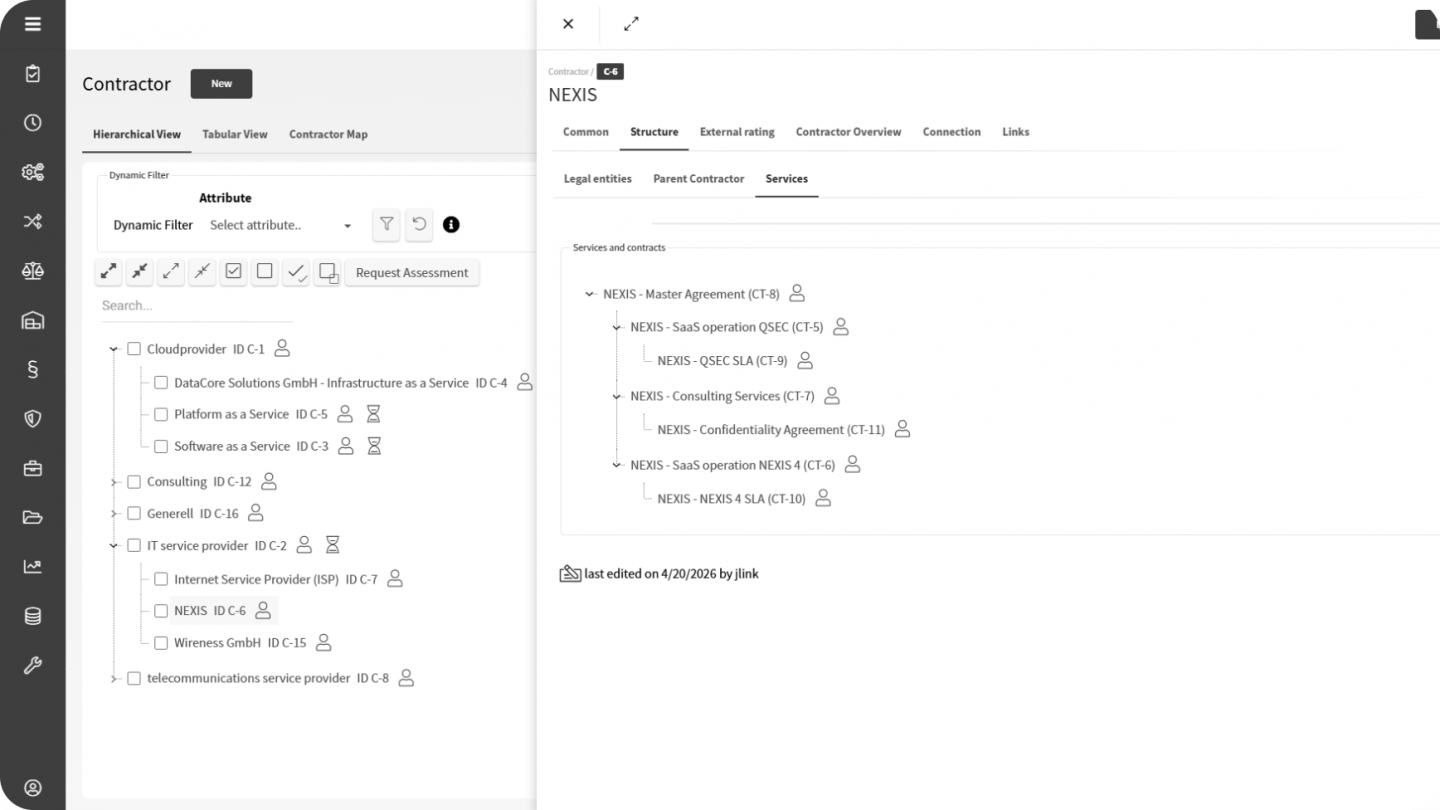
- No centralized provider and contract register
- Self-assessments run through email and spreadsheets
- Sub-contractor relationships are not visible
- Risk classifications are disconnected from business processes
- Audit evidence is assembled ad hoc
- Incidents cannot be traced to providers
How NEXIS Structures Third-Party Oversight
- Register Providers
Build and maintain a current provider register with contracts, relationships, ownership, and risk-relevant attributes. - Assess and Classify
Run structured self-assessments and evaluate providers across defined risk categories. - Connect to Operations
Link provider risks to business processes, assets, incidents, and continuity assessments. - Monitor and Report
Track status, thresholds, and reassessment cycles while generating audit-ready reports and evidence on demand.
Applied to the Situations That Compliance Teams Actually Face
NEXIS Third-Party Risk Management is applied across industries wherever regulatory frameworks impose structured obligations for supplier oversight, ICT provider management, or supply chain due diligence.
ICT Third-Party Risk Under DORA
Financial institutions must maintain a current register of ICT third-party providers, assess their risk, and demonstrate ongoing oversight. Under DORA, this includes contractual obligations, monitoring, and exit-related readiness.
NEXIS supports:
- Centralized provider register with contractual and risk data
- Periodic and event-driven assessment cycles
- Documented monitoring activities for regulatory review
- Integration with ICT risk controls and internal control frameworks
Result:
DORA-related third-party governance becomes demonstrable, with evidence available on demand.
Supply Chain Compliance Under NIS2 and LkSG
NIS2 and the German Supply Chain Act require structured oversight of supplier risks and due diligence across the supply chain. Point-in-time assessments are not enough when providers, dependencies, and obligations change continuously.
NEXIS supports:
- Mapping of sub-contractors and hierarchical provider structures
- Configurable risk categories for security and regulatory criteria
- Direct provider engagement through the Third Party portal
- Full audit trail for assessments and follow-up actions
Result:
Supply chain oversight remains continuous, traceable, and aligned to both NIS2 and LkSG requirements.
Outsourcing Management in Banking and Insurance
BAIT and VAIT require banks and insurers to apply structured risk management to outsourced functions. Provider criticality, reassessment cycles, and evidence of monitoring must remain current and defensible.
NEXIS supports:
- Risk classification by outsourcing type and provider criticality
- Integration with BIA and business process continuity
- Automated reassessment scheduling and escalation workflows
- Reporting aligned to BAIT and VAIT evidence requirements
Result:
Outsourcing registers and risk assessments stay current instead of being rebuilt at audit time.
Third-Party Risk and External AI Services
External AI Services Are a New Third-Party Risk Category
As organizations adopt AI services hosted outside their own environment, a new class of third-party risk emerges. These services access corporate data, influence decisions, and operate within business processes, yet they often sit outside traditional provider governance.
NEXIS extends third-party governance to this category by allowing external AI agents and services to be registered, classified, assessed, and linked to the identity governance processes that control the non-human identities or agents interacting with them. This brings provider governance and identity governance together in one platform, rather than treating them as separate control problems.
Built for the Frameworks That Require Third-Party Oversight
NEXIS supports third-party governance across the regulatory frameworks that require structured oversight of suppliers, ICT providers, and outsourcing relationships.
DORA (Articles 28-30)
NIS2 Supply Chain Security
BAIT / VAIT Outsourcing
ISO 27001 A.15
LkSG / Supply Chain Act
GDPR / DSGVO
BSI IT-Grundschutz

The methods and processes already integrated into Nexis GRC out of the box have been instrumental in helping us establish and operate our Information Security Management System (ISMS) professionally. Its maturity assessment and continuous improvement capabilities enable us to operate, monitor, and further develop the Techem ISMS efficiently while minimizing resource requirements.

Sebastian Fingerloos
Head of Information Security, Techem GmbH
Auditing our infrastructure has become significantly easier and more efficient with the support of Nexis GRC. Based on the auditors’ positive assessment of the platform’s capabilities, we plan to further expand our use of Nexis GRC in line with our evolving requirements.

Hardy Krüger
Data Protection Officer, Information Security Officer, and Head of Document Management, Harzklinikum Dorothea Christiane Erxleben GmbH
With Nexis GRC, we have gained a partner who understands our business and responds openly to our requirements and ideas. Throughout our collaboration, Nexis GRC has consistently demonstrated the value of a true partnership.

Thomas Prigge
Information Security Officer. HanseMerkur Krankenversicherung AG
In the end, Nexis GRC stood out through its strong cost-benefit ratio and its scalability as a single-source platform. Nexis GRC supports the establishment of a consistent understanding of processes across the organization. The system serves as a central platform where all business processes are documented.

Marcel Reifenberger
Chief Information Security Officer & CSO, CANCOM SE
Overall, we are very satisfied with the capabilities of Nexis GRC and plan to further expand and make extensive use of the software in the future. The software provider, Nexis GRC, has proven to be a reliable partner, supporting us with decades of experience gained from delivering GRC and ISMS projects worldwide, and consistently providing the best possible guidance.
Dr. Paul-Martin Steffen
Head of Data Protection and Information Security, DSW 21